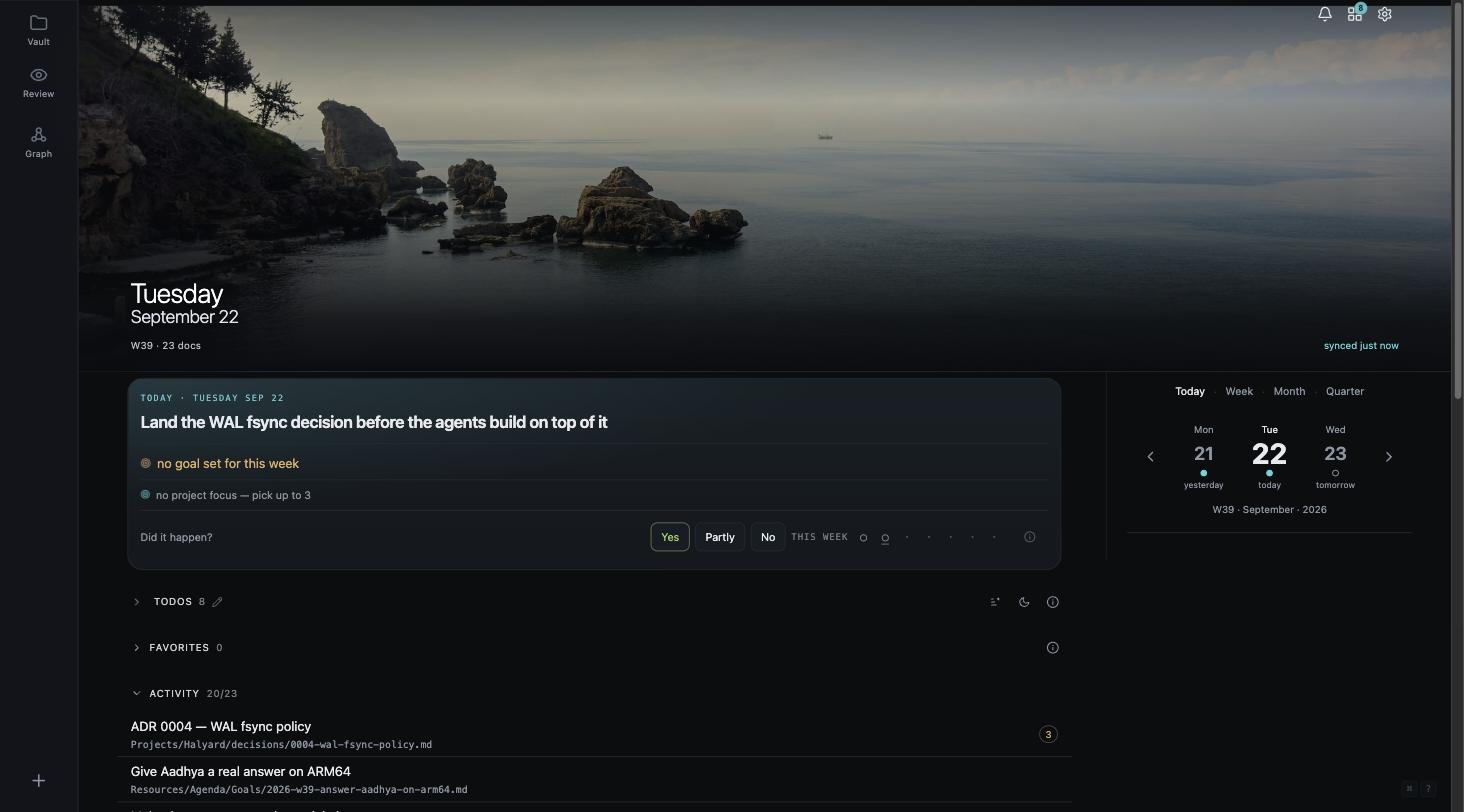
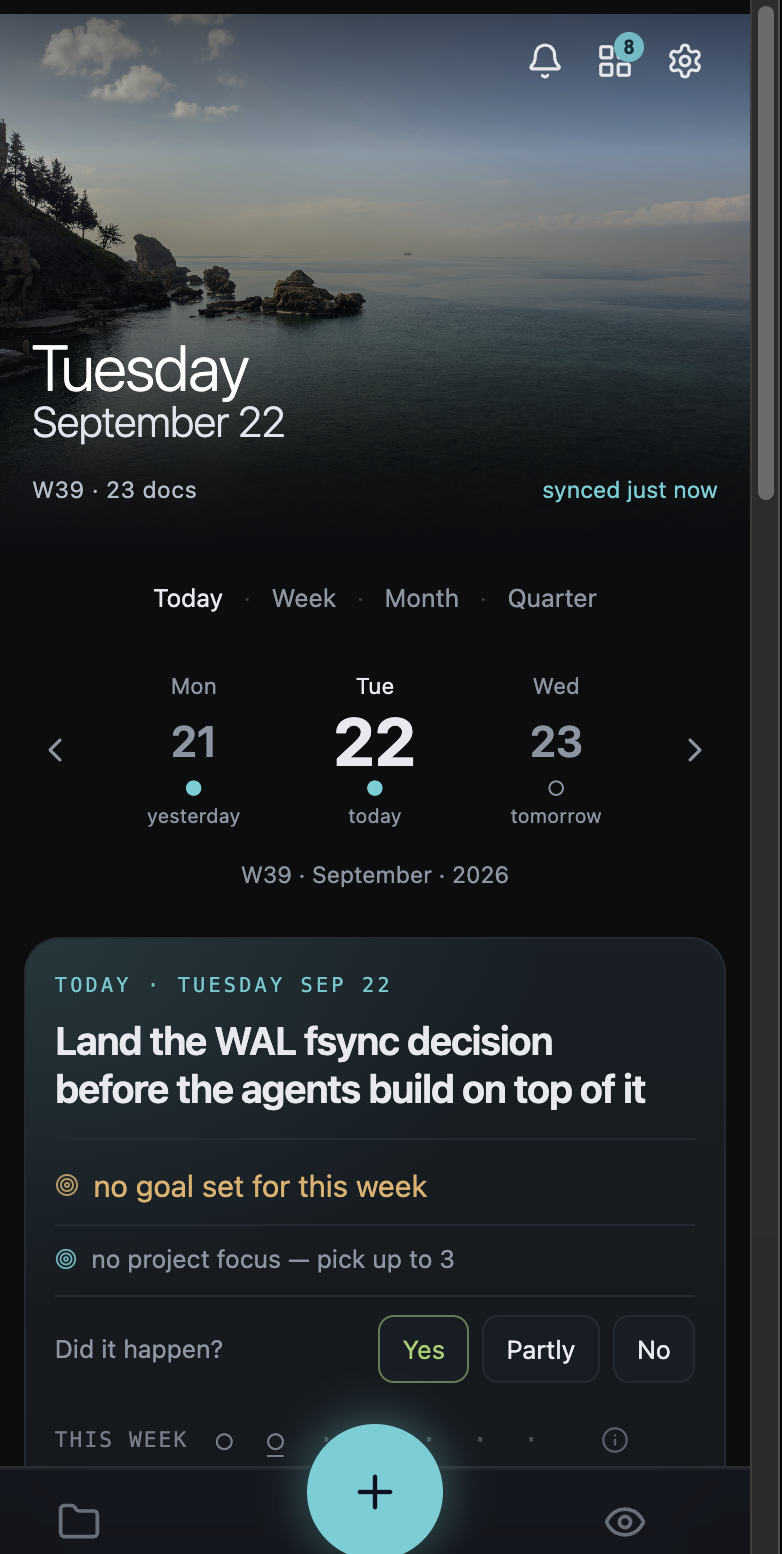
Collab speaks MCP over authenticated HTTP. Every client reads the same intent, live, so nothing has to be exported or pasted.
Invite only · self-hosted
Collab is an intent bus. The intent you write for people and the intent you write for agents live in one place, both can read it, and what changes comes back to you to reconcile. Over markdown you own, with whatever model you use.
Two kinds of intent
Once for the people who will review it, and again for the agents that will build it. The two copies start identical and stop agreeing within a week.
Narrative, argued over, reviewed. An agent gets a pasted excerpt at best, and the doc drifts the day after it is approved.
A decision changes in one and never reaches the other. The argument that changed it is in a chat log nobody can find.
Precise and executable. Each one lives in one repo or one chat, tied to one tool, and none of them keeps the reasoning that produced it.
## Expired trials When a trial ends, the account downgrades to read-only. Users keep their vault and can still search it. A read-only account is a better place to sell from than a locked one.
- on trial_end:
licence.status = "suspended"
block all routes except /billing
- acceptance: suspended user sees
paywall on every request
An illustration: one decision, two documents. The agent shipped the spec, and nobody saw the disagreement.
The intent bus
Collab holds human intent and agent intent side by side, as markdown in git. People read it in the app. Agents read it over MCP. Everything an agent writes back is stamped and waits for you.
A PRD, a spec, a decision record, or a highlight on a single sentence. It is a markdown file in your vault, with no import step.
Claude, ChatGPT, Claude Code, or anything else that speaks MCP queries the same corpus on demand. They read the spec and the PRD it came from, so there is no stale copy.
What an agent wrote arrives stamped and lands in your review queue, attached to the passage it touched. You decide which version of the intent is the real one.
Already writing PRDs for people and specs for agents? This is the beta for you.
Intent at the sentence level
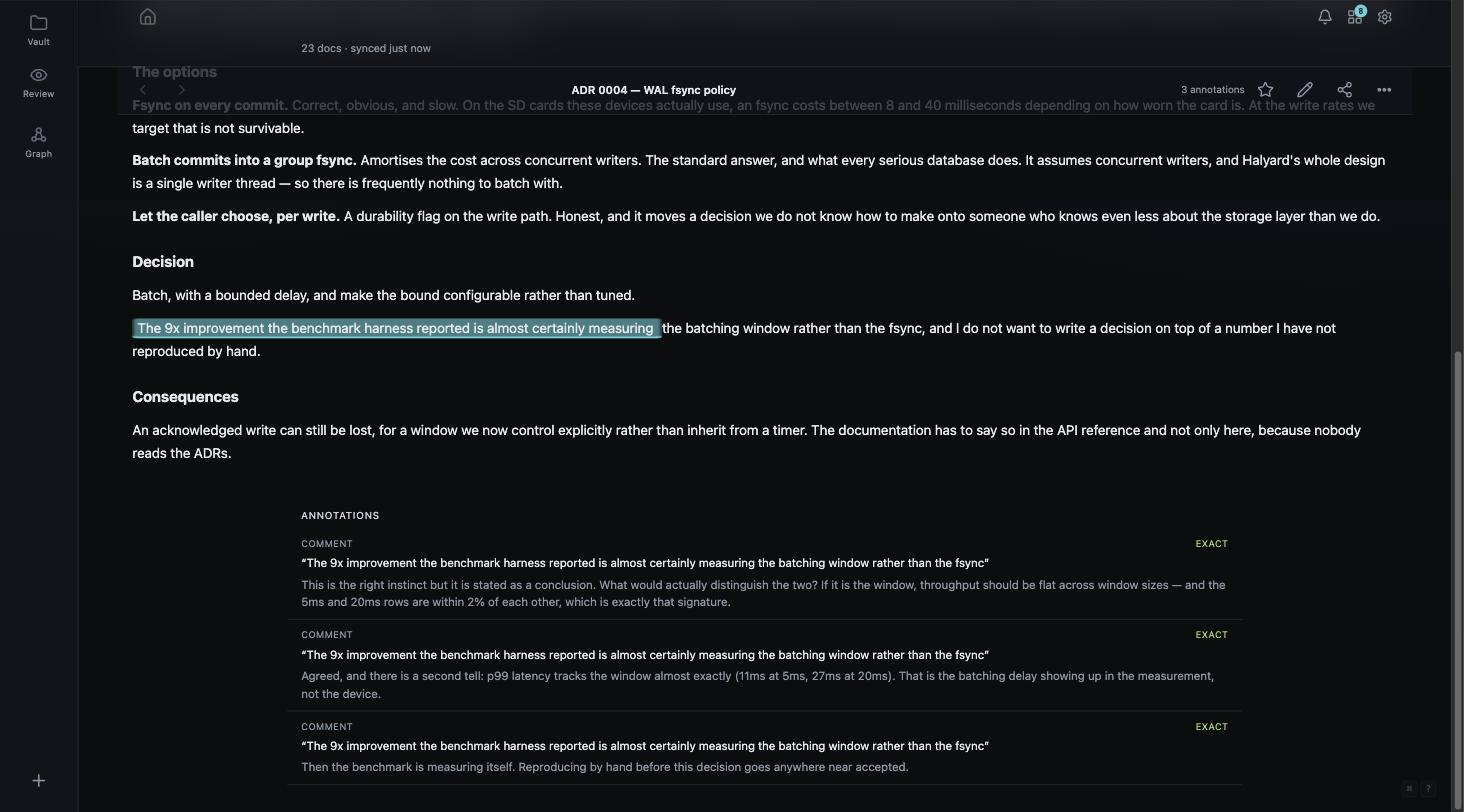
Highlight a passage and argue with it. The thread hangs off that text, and your agents read it over MCP the same way they read the prose. Marking what matters is how you tell an agent what matters, without writing a prompt about it.
When the document is edited underneath, the anchor resolves against the new text or reports itself shifted. It never quietly re-attaches to whatever now sits at those coordinates.
The highlight sits in the document, not in a margin. The thread hangs off that exact run of text, and reports when the text under it has moved.
Portable intent
Start a thought in ChatGPT. Review it on your phone. Build it out in Claude Code. The intent stays in your vault, so changing tools doesn't mean starting over.
Collab speaks MCP over authenticated HTTP. Every client reads the same intent, live, so nothing has to be exported or pasted.
Bring your own OpenRouter key. The provider is a setting, so switching models is a settings change and the vault stays the same.
Send a person a read-only link to the passage, or point another agent at the vault. There are no seats and no shared editing.
The reasoning is the thing that usually gets lost. A decision survives in a commit message. The argument that produced it dies in a chat window, and the next model you open has never seen it. Here it stays attached to the intent, for every tool and for you in six months.
Reconcile, don't excavate
Four agents ran overnight. Two touched the write path. Which two, and what did they change?
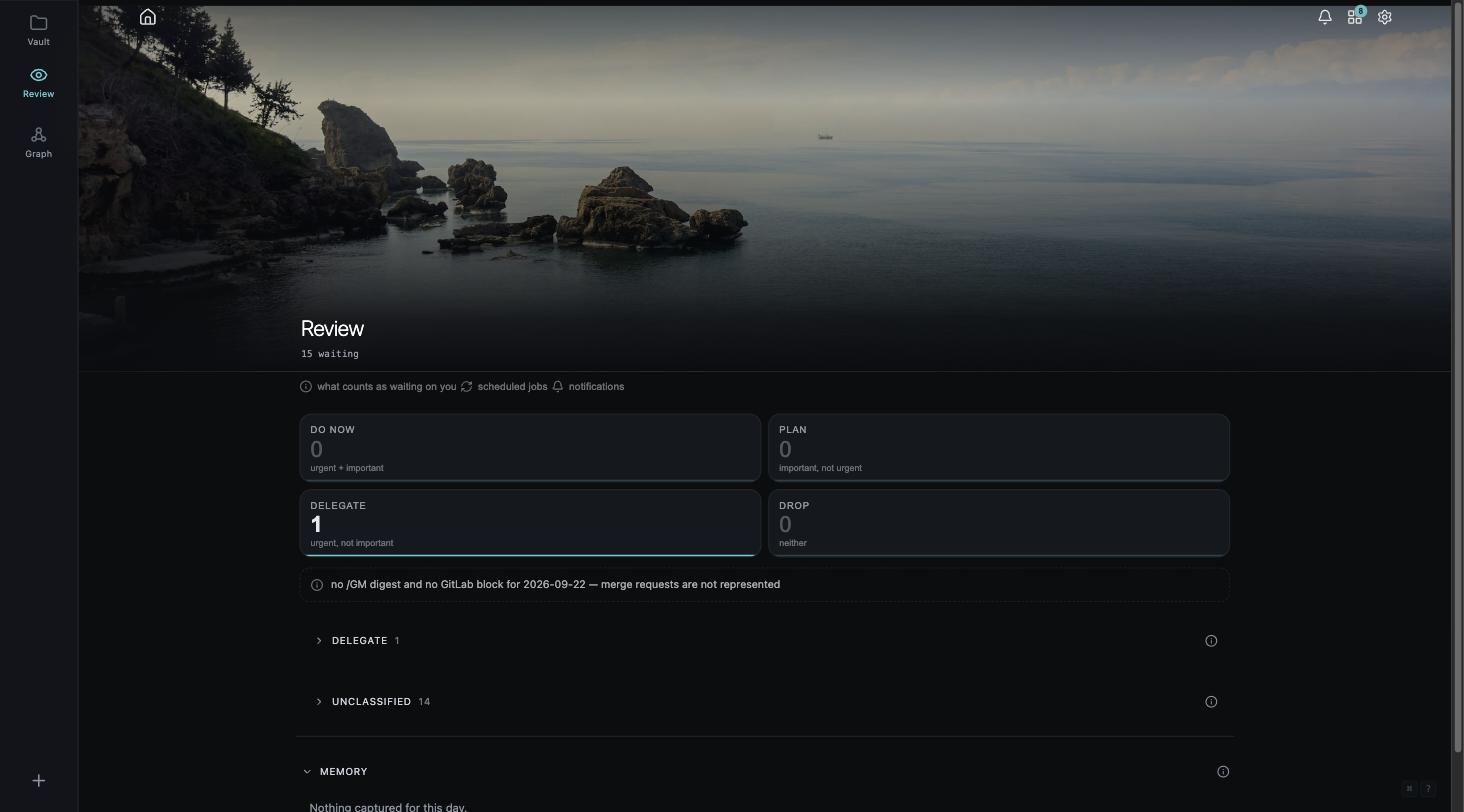
Urgent against important, and it says out loud when a source has not reported, rather than showing a confident zero.
Getting things in
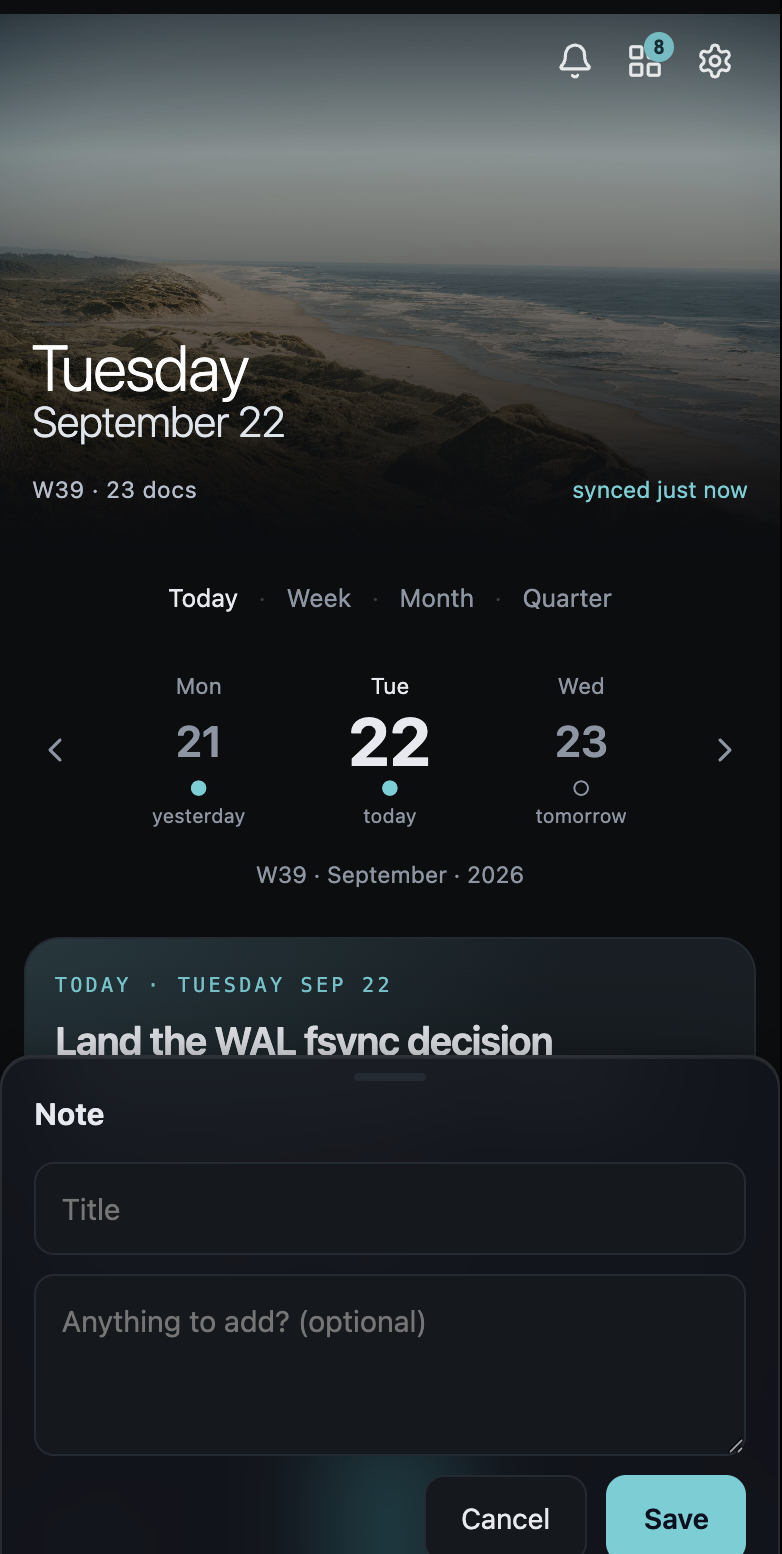
Nothing asks you to pick a folder. Where it lands is Collab's problem — the kind you choose decides, and a title alone is a complete capture.
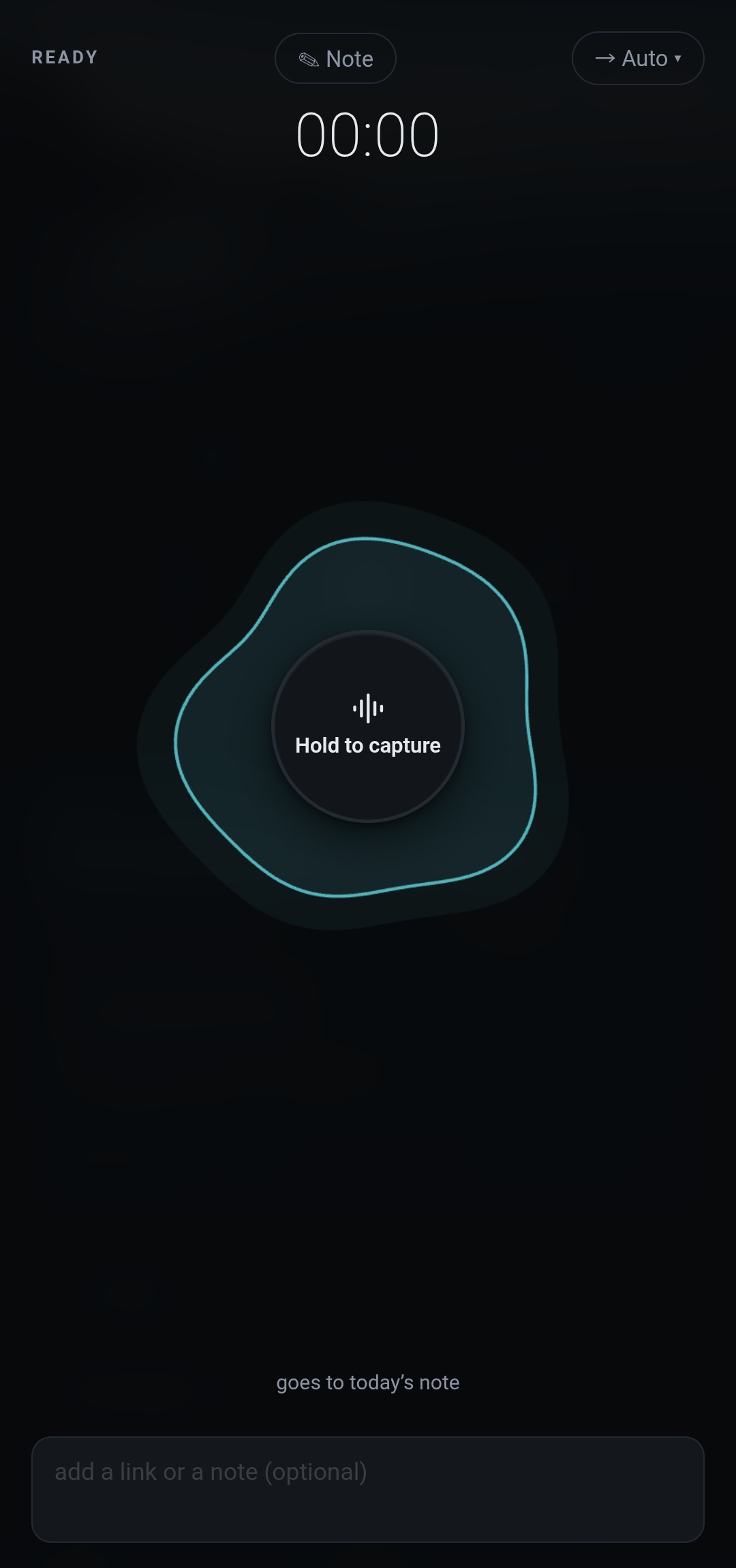
Hold, talk, let go. Transcribed, summarised, titled and filed into today's note with a link back to the audio — then it tells you where it landed. If a recording never rose above the room, you get a discard prompt rather than a file full of nothing.
Tap for whichever mode you are capturing in at the moment — set it to voice, or a meeting note, or whatever today needs. Hold for the rest. It opens over whatever you were looking at, and the marker you type does the routing: a bullet is a thought, - [ ] is a todo.
The Android share sheet, a watch that posts over its own LTE with no phone in the loop, and collab <path> — which prints a URL instead of opening a window when an agent is the one calling it.


The recorder tells you where it is going before you start talking.
It never takes custody
Your notes are a folder of markdown in a git repository before Collab, during, and after. Delete the app and the corpus is byte-for-byte intact — a claim you can verify in ten seconds without reading any code.
It runs on your machine, on your network. The index is a projection: throw it away and it rebuilds from the files, because the files are the source of truth and the database never is.
Embeddings and transcription run locally. Inference goes out only on your own key, to the provider you chose. The vault underneath does not notice any of it.
Collab is a closed-source binary, and you would be running it against your entire personal corpus. If that is disqualifying for you, it is disqualifying, and no amount of copy should talk you out of it.
What is offered instead of source is verifiable behaviour: the files stay canonical on disk and git-mirrored, so you can diff them; it runs on hardware you control, so you can watch what leaves; and agent-authored content is stamped, so you can see what wrote what.
Where it sits
A place for people to write and argue about intent. Agents get an export, and the export is stale by the next edit.
Intent an agent can execute, in one repo, for one tool. People get a diff, and the reasoning isn't in it.
Both kinds in one corpus that people and any MCP agent read live, with every agent change stamped and anchored for you to reconcile. Over files that stay yours.
What it is not
Five to ten people who write intent for both people and agents, and are tired of keeping the two in sync. Free, unpriced, and no card.